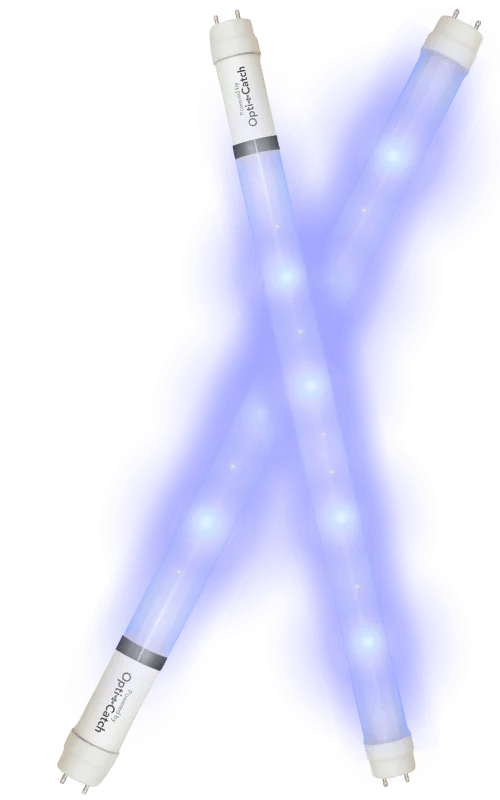


Glass vs Plastic UV Lamps: Why Material Choice Matters in Food Environments
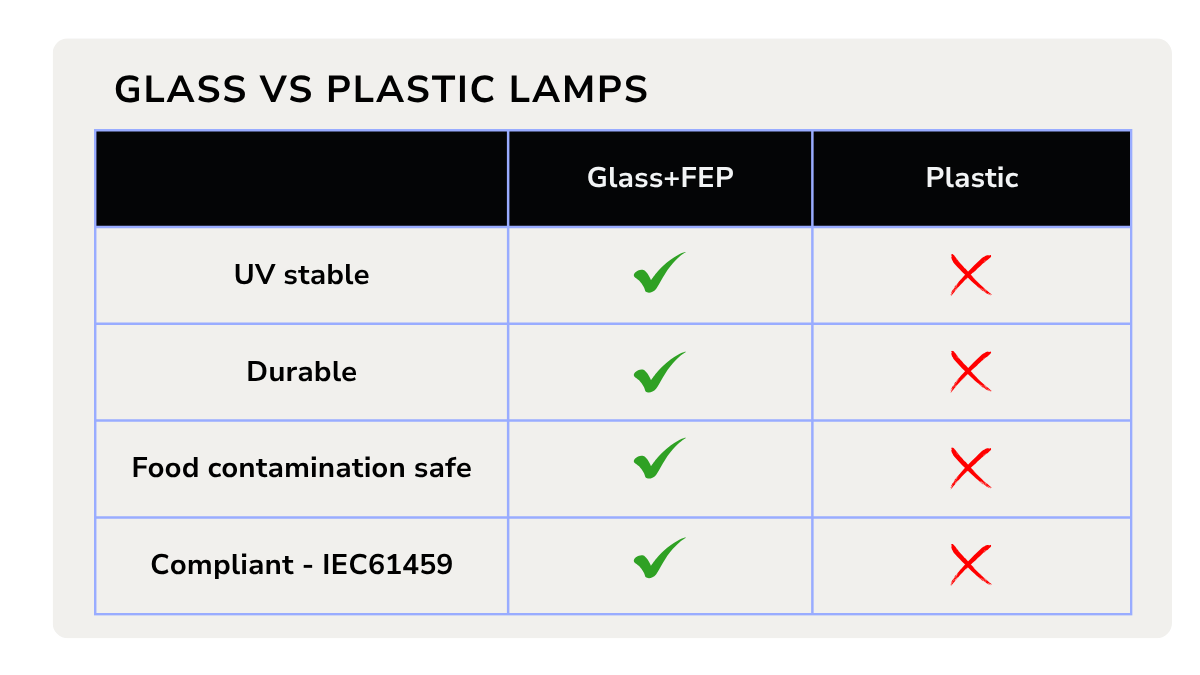
Plastic lamp materials degrade when exposed to UV light and are not suitable for use in food environments where long-term performance and risk control are important.
Independent research shows that FEP-coated glass lamps maintain stable UV transmission over the lifetime of the lamp, helping ensure consistent insect attraction in real operating conditions.
Together with their controlled breakage behaviour, this makes coated glass a widely used solution in food production environments.
In food production environments, material choice is not a secondary detail—it directly influences performance, contamination risk, and compliance outcomes.
When it comes to insect light traps, the choice between glass and plastic UV lamp materials is increasingly important.
While plastic materials may appear to offer a modern alternative, their behaviour under UV exposure has significant implications for both safety and long-term reliability.
Why the Lamp Material Matters
Insect light traps rely on ultraviolet (UV) light to attract flying insects. For this system to remain effective, the lamp material must remain stable under continuous UV exposure.
Many plastics used in LED housings, including acrylic-based materials such as PMMA, can degrade over time when exposed to UV light. In practice, this degradation can lead to:
- Reduced structural integrity
- Increased brittleness
- A higher likelihood of cracking or fragmentation
Unlike visible breakage, this can occur gradually, making deterioration harder to detect during routine inspections.
In food production environments, this creates an unacceptable level of uncertainty around contamination control.
Contamination Risk in Food Environments
If a plastic-bodied lamp fails, it can produce small, sharp fragments that are difficult to detect and cannot be reliably identified using standard screening processes.
In environments governed by strict food safety standards such as BRCGS, this creates a clear risk:
- Undetected plastic fragments can enter production areas
- Product contamination may go unnoticed
- The result can be costly recalls or compliance breaches
Plastic does not eliminate contamination risk - it changes the form and detectability of that risk.
Why Glass + FEP Is the Proven Food Safe Option
A glass-bodied UV lamp with an FEP (fluorinated ethylene propylene) coating is widely used in food, pharmaceutical, and hygiene-critical environments.
This design offers two key advantages:
1. Stable UV performance
Glass is inherently UV-stable and does not degrade under exposure, allowing consistent transmission of UV light over the life of the lamp.
2. Controlled breakage behaviour
The FEP coating is designed to contain glass and phosphor in the event of breakage, reducing the risk of contamination spreading into the environment.
Together, these characteristics support both effective insect attraction and controlled risk management.
By contrast, plastic-bodied lamps have no protective coating and continue to pose a contamination risk. According to the BRCGS, plastic contamination remains a major issue, with product recalls reported almost every month.
And while not all of these incidents stem from lighting, the pattern is clear: plastic is not considered a safe material in food preparation areas. Many sites are actively reducing or eliminating unnecessary plastic equipment for the same reason - it’s as undetectable as glass if it enters the food chain.
Performance Over Time
Material choice also has a direct impact on performance.
Plastic materials exposed to continuous UV light can absorb part of the emitted energy. Over time, this reduces the amount of UV reaching the surrounding environment, which can affect insect attraction efficiency.
Glass does not exhibit this behaviour. When combined with an FEP coating, it provides:
- Consistent UV output over time
- Reliable insect attraction performance
- Stable operation throughout the lamp's lifecycle
In pest control environments, performance degradation is not just an efficiency issue - it can also compromise site hygiene standards.
A Proven Approach in Regulated Environments
Industry Standards and Compliance Alignment
Glass with FEP coating has been widely used in regulated environments since the 1990s, particularly in food manufacturing and pharmaceutical applications.
Its continued use reflects its consistent performance in environments where both safety and reliability are essential.
At Opti-Catch, our retrofit LED insect light trap lamps follow this same principle: glass-bodied, FEP-coated, and fully shatterproof. They deliver all the energy-saving and maintenance benefits of LED while upholding the same high standards of food safety and reliability.
Within this context, Opti-Catch works in partnership with BRCGS to support greater awareness of food safety standards across the pest control industry. This collaboration reflects a shared focus on ensuring that products used in food environments are appropriate for their application, reliable in operation, and aligned with evolving compliance expectations.

What This Means for Pest Controllers
For pest control professionals, lamp specification has a direct impact on both client safety and compliance assurance.
In practice:
Glass + FEP coated lamps:
- Maintain stable UV performance over time
- Provide controlled containment in the event of breakage
- Are widely used in hygiene-critical environments
Plastic-bodied lamps:
- Can degrade under UV exposure
- May reduce long-term performance consistency
- Introduce unpredictable fragmentation risks
Selecting the correct solution is therefore not only a technical decision, but also a compliance and risk management consideration.
Key Takeaways
In insect light traps, lamp material plays a critical role in both performance and food safety outcomes.
Plastic materials can degrade under UV exposure, introducing uncertainty in both performance and contamination control. Glass with FEP coating remains the established solution in hygiene-sensitive environments, offering stable UV transmission and controlled breakage behaviour throughout the lamp’s lifecycle.
For food production sites, it is this combination of consistency, predictability, and proven use in regulated environments that continues to define the standard.
More blogs
When You Buy an LED Insect Light Trap, What Are You Really Buying?
%20(1).png)
From Packaging to Pest Control: Why Risk Assessment Matters
.png)
Electric Fly Killer Standards: Why Pest Controllers Need Greater Transparency
Want to keep your insect traps with Opti-Catch?
Fill out the contact form below to enquire