

From Packaging to Pest Control: Why Risk Assessment Matters
A recent HACCP International article highlights the importance of assessing all materials and equipment used within food production environments. This article explores how the same risk-based principles can be applied to insect light trap lamps, helping manufacturers balance sustainability objectives with food safety requirements.
.png)
Food manufacturers today face increasing pressure to improve sustainability while maintaining the highest standards of food safety.
Across the industry, businesses are reviewing everything from packaging materials and processing equipment to lighting and pest control systems in search of more sustainable solutions. However, as a recent article from HACCP International highlights, sustainability claims should never replace proper food safety assessment.
The article makes an important observation:
"Any material, equipment, consumable or service used in food manufacturing, handling, storage or preparation can affect food safety outcomes."
While the article focuses on food packaging, the principle applies equally to every product used within a food production environment, including insect light traps.
The sustainability case for LED
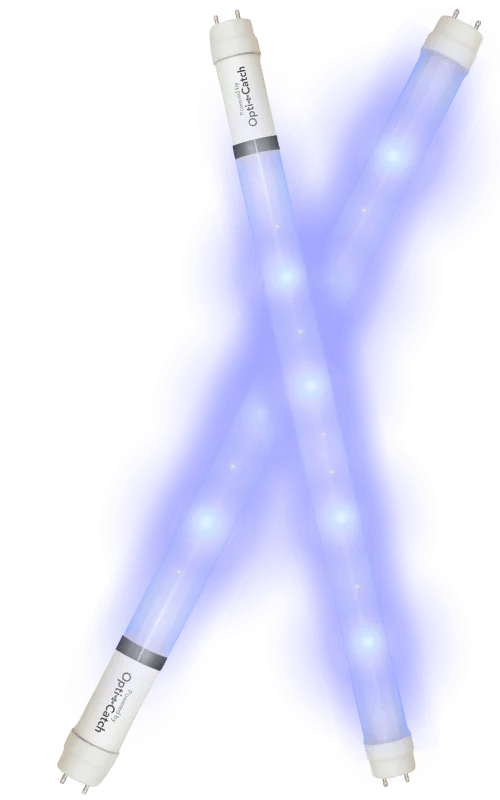
The transition from fluorescent to LED technology has brought significant sustainability benefits to insect light traps.
Compared with traditional fluorescent lamps, LED lamps can offer:
- Lower energy consumption
- Longer operating life
- Reduced maintenance requirements
- Less waste generated through lamp replacement
These benefits have helped many food manufacturers reduce both energy costs and environmental impact while maintaining effective flying insect control.
Importantly, these sustainability advantages result from the LED technology itself, regardless of whether a lamp is constructed from glass or plastic.
When material discussions become oversimplified
As LED adoption has increased, discussions around lamp construction materials have become more common.
In some cases, plastic lamps are promoted as a safer alternative because they contain no glass. While this may seem a straightforward conclusion, food safety risk assessments are rarely that simple.
The HACCP article serves as a useful reminder that materials should be evaluated based on their impact on food safety outcomes rather than assumptions associated with a particular material type.
The question is not simply whether a lamp contains glass.
The more important question is:
What happens if the lamp becomes damaged, and how is the risk controlled?
Understanding brittle material risks
Food manufacturers have long recognised that physical contamination risks are not limited to glass.
Many food safety management systems include controls for both glass and brittle plastics because both materials can present contamination risks if damaged.
This is particularly relevant in environments where materials may be exposed to cleaning chemicals, physical impacts, temperature fluctuations or prolonged UV exposure.
As materials age, their properties can change. Plastics, for example, may become more brittle over time depending on the material type and operating conditions.
For this reason, food safety professionals typically assess risks based on the behaviour of a product throughout its service life rather than relying solely on the material from which it is made.
Taking a broader view of food safety risk
A robust food safety assessment considers a range of factors, including:
- Product durability
- Likelihood of damage
- Fragment retention measures
- Inspection procedures
- Maintenance requirements
- Expected service life
- Environmental conditions
This approach reflects the broader principle highlighted by HACCP: every component introduced into a food production environment should be assessed through a risk-based lens.
In many food production environments, the objective is not necessarily to eliminate every potential source of risk, but to implement effective controls. This principle underpins the widespread use of shatterproof coatings on glass components used throughout food manufacturing. By containing fragments in the event of breakage, these protective measures help manufacturers manage contamination risks while benefiting from the performance characteristics of the underlying material.
The same risk-based approach can be applied to assess insect light trap lamps and other equipment used in food production environments. Rather than focusing solely on whether a product is made from glass or plastic, food safety teams should consider how risks are identified, controlled and monitored throughout the product's service life.
Asking better questions
As food manufacturers continue to pursue sustainability goals, it is important that environmental benefits and food safety considerations are evaluated together, but not confused with one another.
The move from fluorescent to LED technology delivers clear sustainability advantages through reduced energy consumption and longer lamp life.
However, when assessing food safety risks, the discussion should go beyond whether a product is made from glass or plastic.
Instead, food manufacturers should ask:
- How does the product perform throughout its service life?
- What happens if it is damaged?
- What controls are in place to minimise contamination risks?
- Does the solution meet both sustainability and food safety objectives?
By focusing on evidence-based risk assessment rather than assumptions about materials, manufacturers can make more informed decisions that support both food safety and sustainability goals.
More blogs
When You Buy an LED Insect Light Trap, What Are You Really Buying?
.png)
Electric Fly Killer Standards: Why Pest Controllers Need Greater Transparency
.png)
What Happens If an Insect Light Trap Lamp Breaks?
Want to keep your insect traps with Opti-Catch?
Fill out the contact form below to enquire